
Black History Month Spotlight: Breakthrough Leadership and Excellence by Design at Moody Nolan
By AEC Unites · February 28, 2026
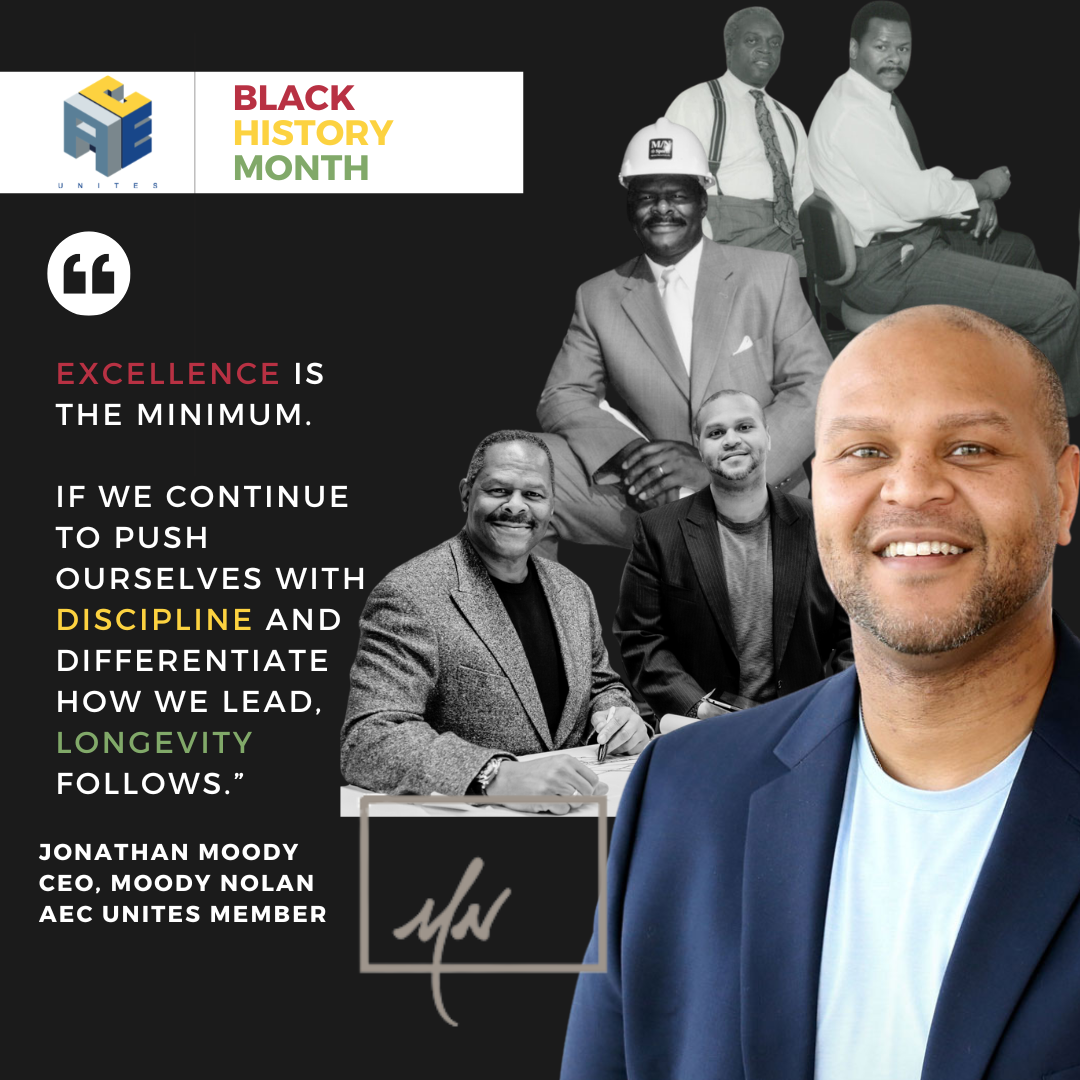
As we close out Black History Month, we reflect on leaders who did not simply inherit legacy — they expanded it. In the AEC industry, where credibility is earned project by project and room by room, longevity requires more than talent. It requires a mindset.
For Jonathan Moody, CEO of Moody Nolan, that mindset was shaped early. Growing up in a firm founded by his father, Curt Moody, he witnessed firsthand what it meant to build credibility in spaces where expectations were high and opportunities were not guaranteed.
“Excellence has always been the minimum requirement for us to maintain success,” Moody says. “We’ve always approached what we do with a competitive mindset, knowing we’d need to prove ourselves in each new room we enter.”
At Moody Nolan, excellence was never a marketing strategy. It was survival strategy. It was growth strategy. It was the standard.
His father often reminded him: no one can argue with success. That belief became foundational — not just as motivation, but as operating philosophy. Performance silences doubt. Consistency builds scale. Discipline creates longevity.
Competitive Excellence as Culture
Moody does not speak about success as a destination. He speaks about it as responsibility.
“If you can see it, you can be it,” he reflects. “If he did it, we can do it too.”
Every milestone in the firm’s history represented a breakthrough. Each project, each expansion, each national recognition marked a moment where the firm pushed beyond what had previously been done.
That awareness shapes how Moody leads today. Achievement is proof of possibility — not a signal to slow down.
“We lead with the mindset of always challenging ourselves,” he says. “Breakthrough moments happen because you are willing to stretch beyond what has been done before.”
Leadership Beyond Titles
At Moody Nolan, leadership is not confined to hierarchy.
“Good ideas can come from anywhere,” Moody explains. “If you put that mindset into action, it means anyone can lead and anyone can contribute something meaningful to a project.”
This belief influences how the firm designs. By recognizing that leadership also exists within the communities they serve, Moody Nolan approaches architecture as collaboration rather than imposition. Design becomes responsive. It reflects lived experience, not just technical mastery.
The result is work that resonates — with clients and with communities.
Diverse by Design
As projects and societal needs grow more complex, Moody believes one principle remains constant: diversity strengthens outcomes.
“Diverse by design,” he says. “Our collective differences are opportunities to build strength.”
For Moody Nolan, diversity is not symbolic. It is structural. It informs thinking, expands creativity, and strengthens execution. It is how the firm remains innovative and competitive at scale.
Redefining the Future of Building
Looking ahead, Moody sees an industry at an inflection point.
“Traditional boundaries and limitations of architecture are fading,” he notes. “Clients are open to creative approaches about who owns, who finances, and who creates space.”
For him, this shift represents possibility. The AEC industry is beginning to ask more expansive questions about ownership, collaboration, and community impact. Firms willing to rethink traditional models will shape what comes next.
Continuing the Breakthrough
As Black History Month comes to a close, Jonathan Moody’s leadership reflects continuity — not just of a firm, but of a philosophy. Competitive excellence. Inclusive leadership. Breakthrough thinking.
Moody Nolan stands as an example of how generational firms continue to redefine scale, influence, and impact in the built environment.
At AEC Unites, we are proud to spotlight leaders who not only build structures, but expand opportunity and strengthen the ecosystem for the next generation of industry innovators.
At AEC Unites, we are proud to elevate leaders who are not only building structures, but redefining standards and strengthening the ecosystem for the next generation of architects, engineers, and builders.